Key takeaway
On-site car key programming depends on the vehicle and key. Have the make, model, year and proof of ownership ready before calling.
On-site car key programming: how it works
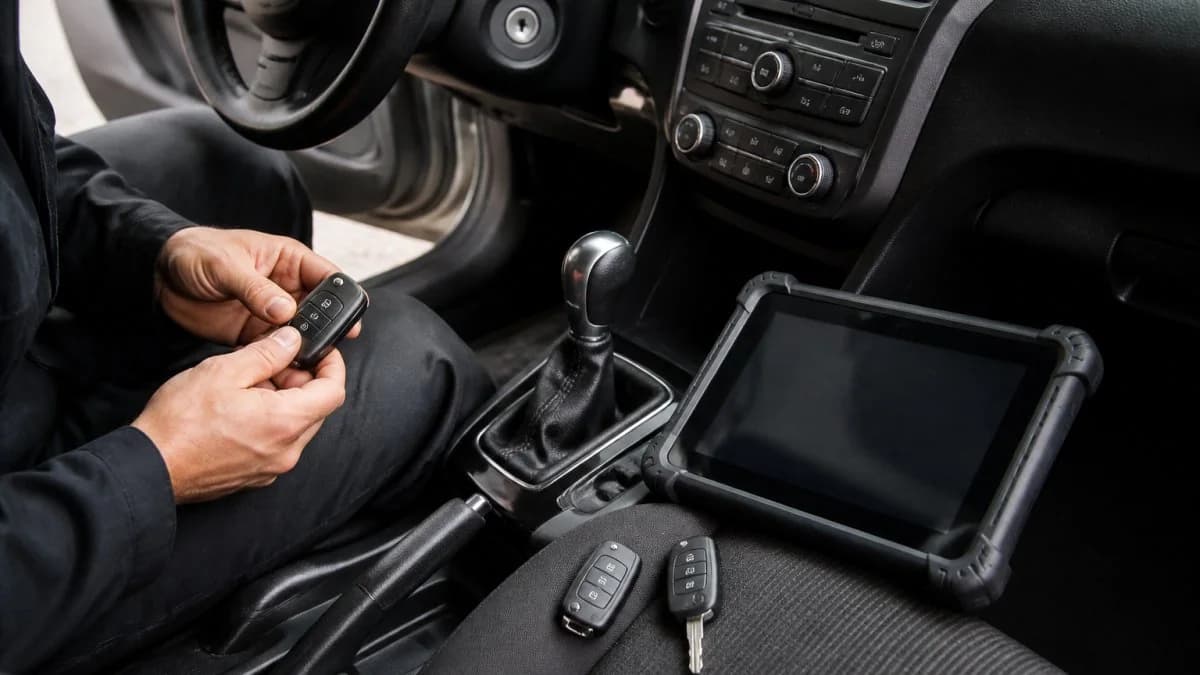
The on-site car key programming is to code a key directly on your vehicle, at home or at work, without towing or a dealership visit.
The operation takes a few minutes once the equipment is in place.
Programming, copying or replacement: three different operations
Confusing these three terms often leads to poor expectations of prices or delays.
- Key duplication copies an existing key that still works. It is the fastest operation.
- Programming codes a new or blank key to be recognized by the vehicle.
- Replacement occurs when there is no longer a functional key, often after a loss or theft.
A key copy almost always includes programming. A replacement requires cutting the mechanical blade, and sometimes erasing the old keys of the system.
What the mobile unit brings on site
The advantage of a mobile unit is that it is moving. Your car stays there, the technician comes to it.
This changes everything when the vehicle does not start anymore: no towing, no tow truck fees, no appointments three days later. Work is done in your driveway, at work or in a parking lot.
Documents and information to be prepared before intervention
Prepare your proof of ownership before the technician arrives: without it, the intervention cannot take place.
A car locksmith checks that the person who controls the key is the owner: that's what prevents someone from having a key made for a car that is not his own.
Proof of ownership, VIN and registration
Three elements are usually sufficient to confirm your right to the vehicle:
- The registration certificate on behalf of the applicant
- A photo ID corresponding to the name on the certificate
- The vehicle identification number (VIN), visible on the windscreen or certificate
If the vehicle belongs to a company or another person, a signed written authorization will avoid blocking. Also have the plate on hand.
Smart key programming: steps according to key type
The steps vary according to the embedded technology. A single transponder key does not program as a smart key.
The principle remains the same: the vehicle must recognize the chip before allowing the start. Only the number of components to synchronize changes.
Transponder key and single chip key
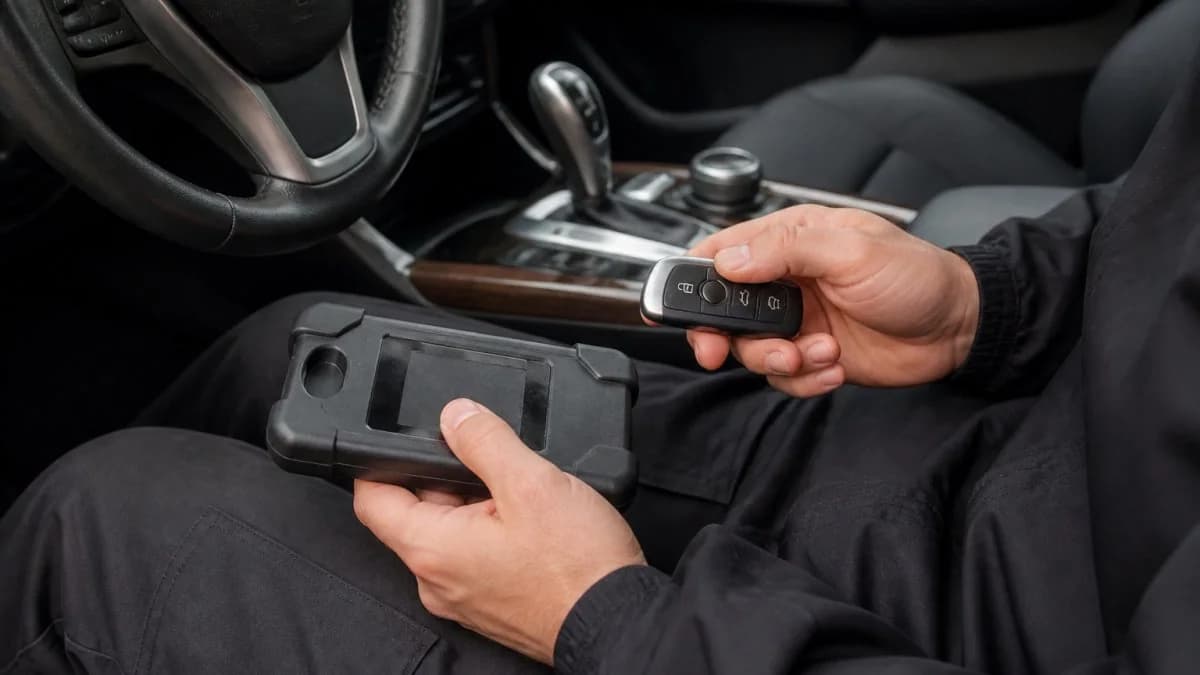
The transponder key contains a passive chip that transmits a code to the immobilizer. Programming takes place as follows:
- The technician reads the immobilizer code via the OBD port
- The blank key is inserted or placed near the drive
- Diagnostic tool writes code in chip
- Vehicle confirms key recognition
For a basic transponder key, the synchronization of the locking remote is added: the door and trunk buttons are paired in the same sequence.
Smart key and remote control
The smart key communicates continuously with the vehicle: programming requires a complete synchronization between the chip, radio transmitter and the keyless start module.
Compatibility becomes critical: a smart key that is not well suited to the anti-theft system will not program, regardless of the quality of the tool.
Re-doing a car key without the original: what is possible
A car key without the original is possible in most cases: the technician reads the data directly into the vehicle.
The original is used to copy, not to allow: the access point is the immobilizer.
Two limits exist: if all keys are lost and the system requires a complete effacement, the operation takes longer.
Unrecognized car key: causes and solutions on site
An unrecognized car key almost always comes from three sources: a weak battery, a de-synchronized chip, or an immobilizer that erased the keys in memory.
The battery is the most common cause: a remote control whose battery is weak and the vehicle refuses to unlock. The replacement solves the problem in seconds.
Desynchronization occurs after a battery change or a drop in the key: the chip loses the link with the module and a reprogramming is required.
The most serious case: the immobilizer erased all the keys after a flight or an electrical breakdown.
Home car key programming: time, coverage and availability
The car key programming at home is based on simple logistics: a mobile technician, an immobilized vehicle, a defined territory. Three variables determine whether the intervention is done the same day or should be planned.
How the actual time period breaks down
The time announced on the phone is not the programming time, but the sum of three steps:
Call us! →
- The call qualification, make, model, year, key type, situation (lost key, not recognized, double to do). A few minutes to confirm if the mobile tool covers the vehicle.
- The technician's movement, the most variable portion. In dense urban areas, an organized service often aims at a window of 30 to 90 minutes. In the periphery or in the region, it can extend for several hours, or even be postponed until the next day.
- The intervention itself, programming usually takes from a few minutes to about thirty minutes depending on the type of key and the number of keys to synchronize.
An announced delay without asking for the exact address or key type is unreliable: confirm the arrival window after confirming compatibility.
Geographical coverage: what changes from one service to another
A mobile service does not have infinite coverage. Three models exist:
- Local coverage, technician stays within a defined radius. Time limits are short, but off-site addresses are refused or billed with an extra charge.
- The service is regionally covered and accepts remote interventions, but plans to travel by sector. The time may be extended to several hours or the following day.
- The service is extended with partners and coordinates a network of technicians and makes the demand more accessible. Availability is better, but quality depends on the assigned partner.
Before confirming, ask if travel expenses apply beyond a certain radius: a simple question that avoids bad surprises.
Availability: why the weekends and weekends are saturated
The demand is expected to follow a predictable pace: key losses occur mainly in the morning before departure for work, at the end of the day and at the weekend.
A well-structured emergency service applies real emergency prioritization:
- Vehicle immobilized in public or dangerous place, high priority.
- Vehicle blocked at home with imminent displacement obligation, high priority.
- Double key to do without emergency, planned according to availability.
This prioritization prevents a customer without emergency from a technician while a vehicle blocks a street or parking.
What to check before confirming the appointment
Four informations accelerate the support:
- The vehicle identification number (VIN) confirms the exact configuration of the immobilizer system.
- The type of key, transponder, chip with remote control, or smart key.
- Is the condition of the vehicle still starting, or is it completely immobilized?
With these four elements, a mobile service confirms compatibility, estimates the arrival window and announces a realistic price before the trip.
Programming cost of a car key: which makes the bill vary
The cost of programming a car key does not have a single price: it depends on the key, the vehicle, the number of keys to synchronize and the context. An honest estimate takes these elements into account before announcing an amount.
The four most important factors
| Factor | What changes | Impact on the invoice |
|---|---|---|
| Key Type | Single transponder, smart chip with remote control, smart key | The more recent the technology, the more the cost increases |
| Make and model | Current or high-end vehicle | Specialized brands require dedicated tools and sometimes software licenses |
| Year of vehicle | Old or recent model | Recent systems are more locked and time consuming |
| Number of keys | One or more | Each additional key adds sync time |
In addition to these four factors, there are two context variables:
- Travel, a mobile service sometimes charges fees beyond a defined radius. In dense urban areas, they are often included; in regions, they can be added.
- Emergency, evening intervention, weekends or a holiday can result in an increase. It's not a routine, but it's common.
Why the forks vary so much from vehicle to vehicle
The same type of key can cost very differently depending on the vehicle. Three mechanisms explain this discrepancy:
- Access to the immobilizer module, on some models, is accessible via the standard OBD port. On others, you have to dismantle part of the dashboard or access a hidden module, which lengthens the workforce.
- Software license, professional diagnostic tools often work by subscription or by purchasing credits per brand. A rare or recent brand may require a costly license to amortize.
- The smart key type, a smart key with keyless start requires a complete synchronization between the chip, radio transmitter and boot module. A single transponder key only requires code writing.
This is why a fixed price announced on the phone without checking the brand, model and year is not reliable. A serious quote requires this information before committing.
Compatibility limits and cases requiring the dealership
Some vehicles resist any mobile intervention, but a credible technician says so before he bills anything.
Typical cases:
- A manufacturer-locked immobilizer module, some manufacturers provide access to security keys to the tools of the official network. An independent tool, even recent, cannot write in the module.
- Too recent, the protocols of the most recent models are not yet integrated into the independent tools. The delay can vary from a few months to more than a year after the release.
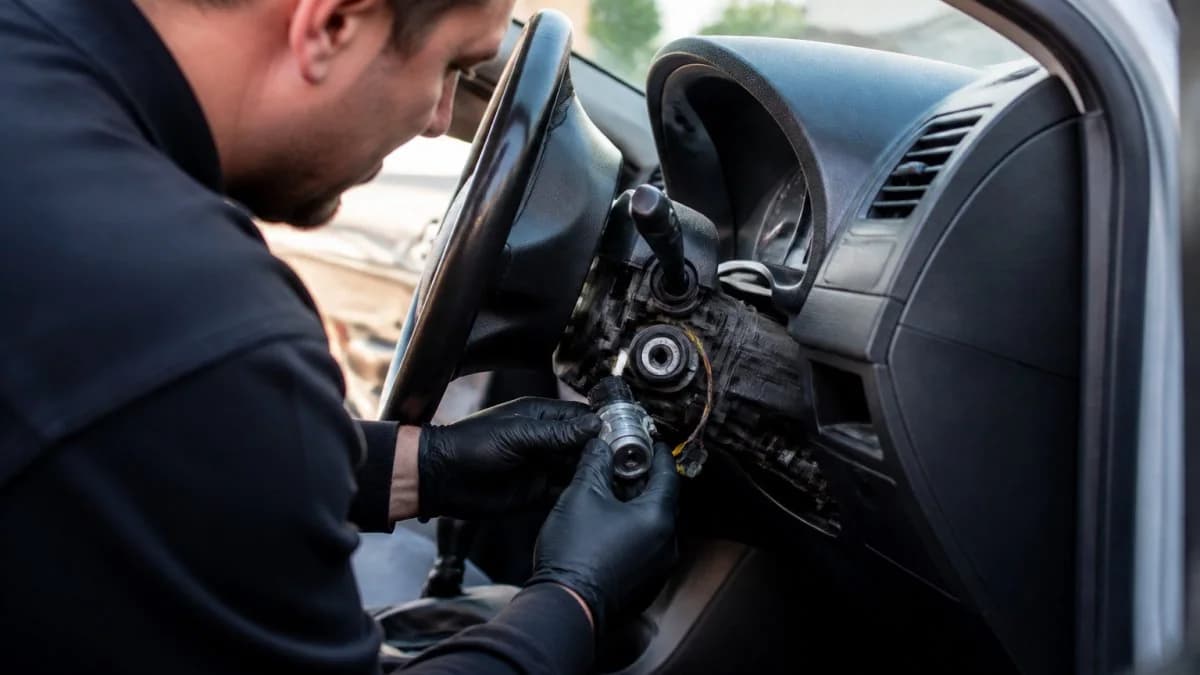
- Damaged system, if the immobilizer module is defective, programming cannot succeed. It is necessary to replace the part, which often requires a workshop.
In these situations, the good practice is to tell the customer clearly before charging.
How to compare two quotes
To compare two offers, always ask:
- The total price, including key, programming and travel.
- The guarantee on the key and on the programming.
- The time limit for intervention confirmed after validation of compatibility.
A quote that refuses to answer these four questions is unreliable.
Security after a loss or theft of key
After a loss or theft, reprogramming is not always enough.
Many ignore this: a stolen key remains functional until its code has been removed from the memory of the immobilizer.
If the theft involves papers or insurance documents, notify your insurer.
Losing his keys immobilizes everything: work, appointments, races.
Common Issues
Can we program a car key without the original?
Yes, in most cases. An auto locksmith with a diagnostic tool can read the vehicle's serial number and create a new key from this information. The owner must provide proof of ownership and the vehicle's VIN. However, some recent models of high-end brands require validation from the manufacturer, which may delay the intervention.
Can an auto locksmith program a smart key?
Yes. Smart key programming is part of the common services of a mobile auto locksmith. The operation consists of synchronizing the key's electronic chip with the vehicle's anti-theft system, and testing the start-up and lock-up. The time required varies according to the vehicle's make, model and year.
How long does it take to program a car key on site?
A typical intervention takes 20 to 60 minutes once the technician is on site. Simple chip keys program faster than smart keys or integrated remote controls. The time to arrive then depends on the distance and timing of the call. For an emergency, it is better to confirm the estimated time on the phone before validating the intervention.
What if my car doesn't recognize my key?
An unrecognized car key can signal a low battery, a de-synchronized chip, or a problem with the ignition switch. Before concluding the worst case, try the emergency key if you have one. If the problem persists, a mobile technician can test the transponder and reprogram the key on site. In some cases, the ignition switch repair will fix the problem without replacing the key.
Call us!